Embedded views: view kinds
One contract every view mounts through — a Dioxus component, a GPU scene, a web view, a Frame surface, an agent's generated UI — a registry of the kinds an app provides, where each can be shown and mounted, and what each may do.
Status: the contract and the registry landed (architect#220). The model is
features/workspace/src/kinds.rs(ViewKinds,KindSpec,ViewHost,Placement,Capability,KindError), wasm-clean inarchitect-workspace’s default build; the contract a kind mounts through isfeatures/workspace/src/ctx.rsViewCtx(featurectx). The workspace’s ownViewis the built-indioxuskind (features/workspace/src/host/mod.rsView,Views::resolve), and an extension’s[[views]] kindis checked when it loads (features/extensions/src/host.rsLoadError::ViewKind,features/extensions/tests/view_kinds.rs).dioxusis built in, andpaintis the first GPU kind (#221): a view that records ananyrenderscene each frame, drawn in-process by Blitz in the pane, with a realViewCtxand typed host data (Paint views, featurespaintandpaint-ui). An app registers it withKindSpec::paint. A host-driven WebGL2 canvas for the same scene is available with featurepaint-web. Other kinds and hosts remain separate work: raw wgpu (#221), WebView/HTML (#222), ImGui from Luau (#223), Frame surfaces (#224, in FastTrackStudios/frame; a minimalframe.surfaceprovider is the frame-view crate), Dioxus in-process and remote (#225), generative UI (#226). Its A2UI payload landed in #228: A2UI (features/a2ui/src/lib.rs), drawn as adioxusview.
A workspace pane shows a view: "session.mixer", "vault.note". What
draws a view is its kind. Until now there was one, a Dioxus
component in the app’s own document. Studio, Task and extensions also
want GPU-painted scenes, web content, script UIs, Frame surfaces and
agents’ generated UIs inside panes. Without one contract each of those
would get its own pane plumbing, input path and lifecycle. With it, a
kind is declared once, mounts through one context, and is refused with a
reason where it cannot run.
an app links crates             ViewKinds                 a host mounts a view
──────────────────              ─────────                 ────────────────────
architect   ── dioxus ──▶  ┌─────────────────┐   resolve_for(kind, host, placement)
frame-view  ── frame.surface▶│ id, provider,   │ ──▶  Ok(KindSpec) → provider gets a ViewCtx
studio      ── gpu ─────▶  │ hosts, placements│ ──▶  Err(KindError) → the reason, in place
                           │ capabilities,   │
                           │ parts           │
                           └─────────────────┘
                                   ▲
extension.toml  [[views]] kind = "…" ── Host::load refuses an unknown kind
The dependency direction#
architect defines the contract; other repos implement kinds. architect never depends on a provider, not even optionally on Frame:
- Frame’s editor and integration already depend on architect. An optional architect → Frame dependency would be a package cycle, and the two git-tag pins would have to move in lockstep (the one-version rule for vox, facet and Dioxus already makes the fleet’s bumps painful).
- The same contract has to serve raw wgpu, a web view, ImGui, remote Dioxus and generated UI. With Frame inside, the contract would be shaped to fit Frame.
- Frame releases on its own cadence, and an app that does not use Frame never builds Vello effects or figcraft.
So a provider crate (frame-view, studio’s GPU host) depends on
architect-workspace (feature ctx) and registers its kinds into the
app’s ViewKinds at startup.
The registry#
features/workspace/src/kinds.rs ViewKinds holds one KindSpec per
kind:
| Field | Meaning |
|---|---|
id (KindId) | "dioxus", "gpu", "webview", "frame.surface", "genui" |
provider | the crate that registered it; "architect" for dioxus |
hosts (Hosts) | what it can be shown in (ViewHost): blitz (a desk window), web (the app built to wasm), webview (a wry view in a pane), plugin (a nice-plug editor window) |
placements (Placements) | where it mounts (Placement): a workspace Pane (tab, dock, float, pop-out), a canvas Overlay, an inline Embed (#180), a PluginWindow |
capabilities (Capabilities) | what it may do (Capability): input, ime, gpu, document, actions, network, untrusted |
parts | a composite’s parts (below) |
ViewKinds::newhas the built-indioxuskind (KindSpec::dioxus);ViewKinds::emptyhas none.ViewKinds::registeradds a kind; an id already provided is refused (KindError::Taken, naming the provider).ViewKinds::resolvefinds a kind or says why not (KindError::Unknown, listing the kinds there are);ViewKinds::resolve_foralso checks the host and placement (KindError::Host,KindError::Placement).
The workspace’s Views carries the app’s kinds (Views::with_kinds, the
built-in one alone by default). A pane resolves its view through
Views::resolve: a view whose kind is not here, or not for this host,
shows the reason in the pane, and the pane keeps its state until the kind
comes back, the same as a view the app does not have.
The contract: ViewCtx#
features/workspace/src/ctx.rs ViewCtx is what every kind is given when
it mounts. It has no Dioxus and no clock of its own, so it builds on wasm,
in a plugin and in a test.
| Field | What it is | How the dioxus kind gets the same today |
|---|---|---|
pane | the pane’s PaneId | use_pane |
kind, host, placement | what draws it, and where | always dioxus, the window’s host, a pane |
geometry (Geometry) | size in logical pixels, and the scale factor | its own layout |
actions (ActionList) | the host’s Action List: the only way a view changes anything outside itself | use_action_list, the commands context |
caller (ActionCaller) | who its runs are made as: the person, or an agent for generated UI; the authorizer and confirmation tickets see it | the app’s caller |
doc (DocRef) | a CrdtDoc, the container path its data lives at, and the crdt::History its edits go through | use_synced_doc and the app’s history |
theme (ThemeTokens) | the theme as tokens by name, for a kind that does not draw in a DOM | ShellTheme in context |
input (InputSink) | pointer, wheel, touch, keys, IME and focus (ViewInput), pushed by the host and drained by the kind | DOM events |
clock (FrameClock) | the host’s clock and a per-frame budget; Frame::over says when to skip work | the window’s frame |
extras (Extras) | typed handles a host adds: the canvas host’s publisher for the Spaces a view draws in (features/canvas/src/space.rs Spaces), a frame engine; shared typed data, HostData<T> (Extras::with_data, read with ViewCtx::data) | Dioxus context |
HostData<T> is one value of the host’s type, shared between the host
and the view: read and update under a lock, a version that moves on
every write so either side can tell it changed, and for a Facet type its
schema (HostData::shape) and JSON both ways (to_json, set_json,
which refuses what is not a T and keeps the value). A pane’s own state
can be typed the same way: PaneHandle::state_as reads it as a Facet
type (None while it is something else, such as text from before), and
PaneHandle::set_state_as keeps it as that type’s JSON.
The input set is the one remote views carry across a process boundary (#176), so a kind sees the same events in-process and remotely. The frame budget is the host’s, not the kind’s: a kind over budget draws less, and never delays the host’s frame (or reaches an audio thread).
The dioxus kind keeps reading these through hooks, so no existing view
changed (View gained draws, which is dioxus unless a provider’s
View::drawn_by says otherwise). A provider for another kind returns a
View whose render mounts its kind in the pane, building its ViewCtx
from the same hooks; a non-Blitz host (a plugin window) builds the
ViewCtx itself.
Paint views#
features/workspace/src/paint/mod.rs is the paint kind’s model (feature
paint: anyrender and peniko, no Dioxus, wasm-clean). A PaintView
is given the pane’s ViewCtx and answers three questions: what an input
event changes (input), what this frame looks like (paint, an
anyrender Scene in its own logical pixels), and what is under a point
(hit). Painter is the host’s side: it drains the ctx’s InputSink
into the view, asks for a frame at the pane’s Geometry and scales it to
physical pixels, and times each frame into FrameStats (the last 1024;
FrameStats::summary is the count, p50, p99 and the slowest, on the
host’s FrameClock). Marks is a display list a view can paint from and
hit-test from, so what is drawn and what the pointer finds are one list:
features/workspace/src/paint/tests.rs
paint_and_hit_testing_read_one_list rasterises 10 000 rectangles and
overlapping bars on the CPU at 1× and 2× and checks the pixel under every
probe against what hit finds there, before and after live input
restyles one.
Feature paint-ui is the Blitz host (features/workspace/src/paint/widget.rs):
PaintWidgetis a Blitz custom widget around aPainter. Blitz gives it its events in the element’s own coordinates (they becomeViewInputs: pointer, touch, wheel, keys, IME preedit and commit, paste) and asks it for a scene at the element’s size; the window’s renderer (Vello on the GPU) draws that scene in the page. It asks for a frame only after input changed something, or every frame while the view says it isanimating.PaintPane { mount }is the pane: it builds the view’sViewCtxfrom the pane (use_pane), the app’sArc<ActionList>in context (run as the app’s caller), the shell’s theme as tokens (shell_tokens, read as colours withThemeTokens::color) and a clock from the pane’s start.PaintMount::new(make)names the view,extrasthe host’s typed data,statsaFrameStatsthe host reads elsewhere,budgetthe frame budget. ClonePaintMount::wake_handlebefore mounting and callPaintWake::wakeafter external data changes; it marks the pane dirty and requests a window redraw, including from a worker thread. Each mounted pane needs its own handle. Shell theme changes update the existing view’sViewCtx::themeand request a frame; read tokens during input or paint rather than caching them only at construction. A custom host can update aPainterwithPainter::set_theme. Mounted Blitz document tests infeatures/workspace/src/paint/widget/document_tests.rscheck both paths against CPU-rendered pixels and confirm they return idle; the external wake path is exercised at 1× and 2× display scale.- A press or a tab gives the widget the focus. While it has it the window’s IME is on, so composed text reaches the view.
Feature paint-web provides features/workspace/src/paint/web.rs
WebPaintSurface, a host-driven WebGL2 canvas on wasm. The host creates
a Painter with a ViewCtx for ViewHost::Web, passes it and the canvas
to WebPaintSurface::new, and registers KindSpec::paint_web if it uses
the kinds registry. A host supporting both Blitz and web can register
KindSpec::paint().host(ViewHost::Web) once. The view records logical
pixels; the surface sizes the canvas and scales its scene using Geometry.
The host forwards ViewInput in canvas-local logical pixels, forwards theme
and size changes, and requests a browser animation frame after changes. On
that frame it calls draw, and requests another only while wants_frame
is true. draw skips an idle surface; invalidate marks externally changed
data dirty. hit uses logical coordinates. WebGL2 initialization, rendering,
lost contexts, and unsupported sizes return errors; context restoration and
DOM event wiring belong to the host. features/workspace/examples/paint_web.rs
and features/workspace/examples/paint_web.html show the host-driven path.
The browser smoke page features/workspace/examples/paint_web_test.html
checks pixels, logical input, 2× sizing, invalid dimensions and idle draws.
From the repository root, build and serve it with a matching wasm-bindgen:
cargo build -p architect-workspace --example paint_web --features paint-web --target wasm32-unknown-unknown
mkdir -p target/paint-web-smoke
wasm-bindgen --target web --no-typescript --out-dir target/paint-web-smoke target/wasm32-unknown-unknown/debug/examples/paint_web.wasm
cp features/workspace/examples/paint_web*.html target/paint-web-smoke/
python3 -m http.server 18763 --directory target/paint-web-smoke
Open paint_web_test.html in a WebGL2 browser; the page says whether it
passed. Frame counts establish skipped host submissions, not GPU utilization.
Feature paint-web-ui adds the Dioxus browser adapter in
features/workspace/src/paint/web_ui.rs. Create one WebPaintMount per
pane with a factory that returns a Painter configured for ViewHost::Web,
and render WebPaintPane { mount, theme } inside a sized parent. Pass updated
theme tokens as the theme prop. Keep WebPaintMount::wake_handle and call
WebPaintWake::wake on the browser thread after changing shared host data,
including when asynchronous layout completes. Wakes coalesce into animation
frames; views that report animation continue until idle. Pointer positions are
canvas-local logical pixels, while the adapter supplies the device pixel ratio
through geometry once. It forwards pointer, touch, wheel, keyboard, focus and
composition events. The example features/workspace/examples/paint_web_pane.rs
shows the mount and wake contract.
The browser check features/workspace/examples/paint_web_pane_test.html
exercises hidden mount, theme, wake coalescing, idle frames, logical pointer
input and DPR sizing. Build paint_web_pane with feature paint-web-ui, run
wasm-bindgen on the resulting wasm as above, and serve the example HTML
beside the generated files. Its frame counts measure scene recordings, not GPU
utilization.
Its limits for now: the IME’s candidate window is not placed at the
view’s caret (no cursor area is set), a write to HostData or the
InputSink needs an explicit wake, and FrameStats times the view’s input and
recording, not the GPU’s raster. WebGL context restoration and a WebGPU backend
are not implemented; plugin hosts mount no
paint view yet. A Frame
surface can draw through it in-process instead of in a process of its
own.
Composite kinds#
The Frame editor is one view made of several panes that share state per
document: a canvas (a GPU kind) and panels (Layers, Design, Assets,
Bindings: Dioxus kinds). That is a composite kind: a KindSpec with
parts, each Part an id and a registered kind.
ViewKinds::registerworks out a composite’s reach from its parts: its hosts and placements are those all its parts share (within what it declared), its capabilities what any part has. A part must be registered first, cannot itself be a composite, and is named once (KindError::Part).- Each part opens as a pane of its own, so the host arranges them like any panes: docks, tabs, floats, pop-outs, a preset screenset.
- The parts share one state per document, keyed by the
DocRef’s document and path: the provider keeps a map from that key to its state and each part’sViewCtxfinds it there. Undo is the document’s oneHistory, so ⌘Z steps through every part’s edits in one order.
The registration and its checks are built (kinds.rs tests
a_composite_shares_its_parts_reach); the shared per-document state is
the provider’s (frame-editor), built with it.
Extensions name a kind#
An extension’s manifest names the kind of each view it adds:
[[views]]
id = "panel"
title = "Panel"
kind = "frame.surface"
A view that names none is dioxus: a process extension’s own Dioxus view,
drawn remotely (docs/content/features/remote-views.md). The host checks
every view’s kind before anything of the extension starts, through the
same Host::load diff as its actions and settings: give it the app’s
kinds with Host::with_view_kinds (the built-in one alone otherwise). A
kind the app has no provider for refuses the load with its reason,
its view panel: no provider for the view kind “frame.surface” in this app (it has: dioxus), a loaded copy stays as it was, and nothing of the new
one lands (features/extensions/tests/view_kinds.rs).
The sandbox’s gallery#
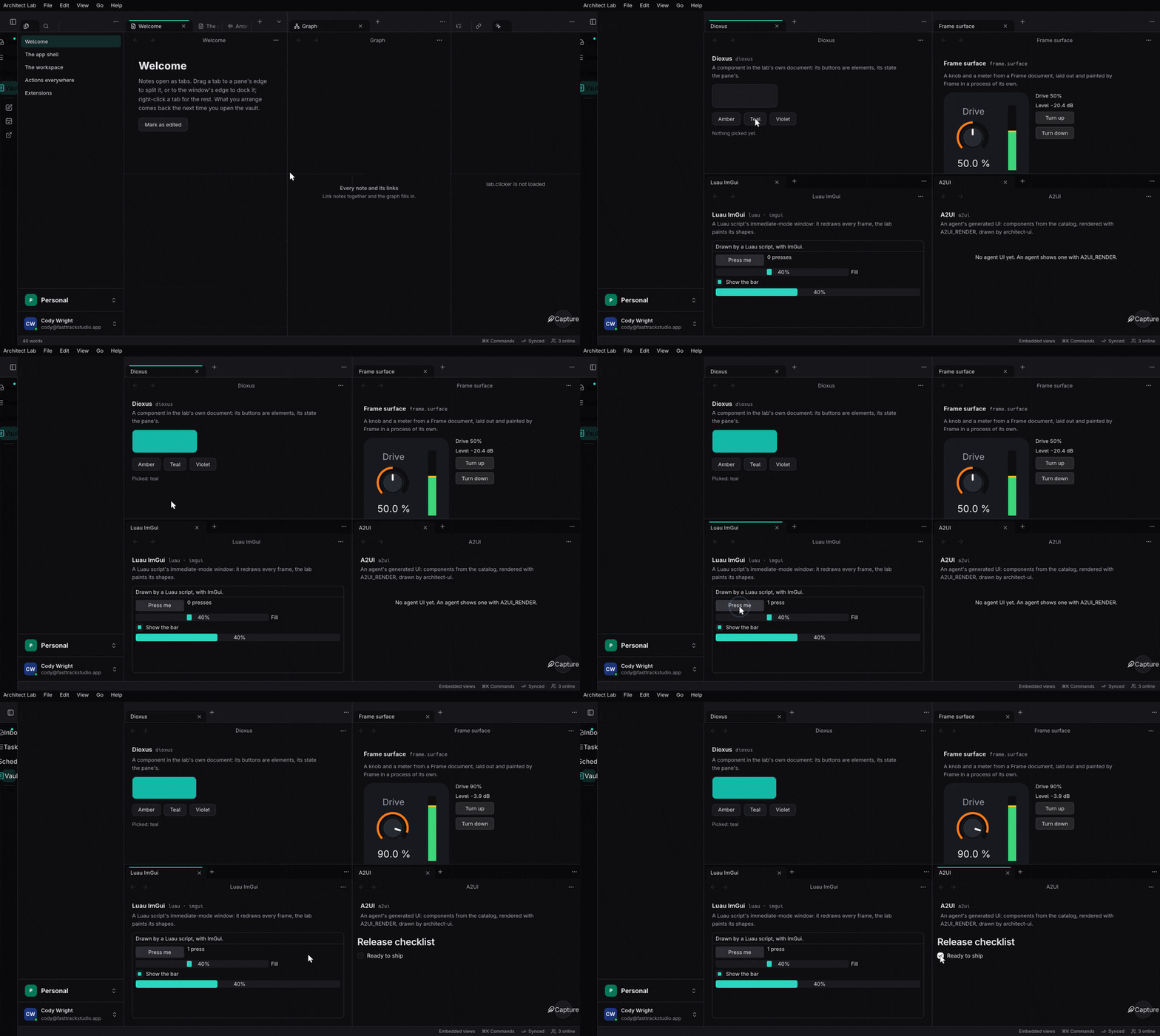
The sandbox’s Vault keeps one pane of each kind it shows in a screenset,
“Embedded views” (⌘3, the palette’s “Load screenset: Embedded views”, or
WORKSPACES_LOAD {"name": "Embedded views"} over MCP and the CLI): a
Dioxus component, a Luau script’s ImGui window, a Frame surface, the
A2UI surfaces and a paint view, each naming its kind
(apps/ui/src/embedded.rs). The paint pane (apps/ui/src/paint.rs)
draws a 100 × 100 grid of rectangles: the pointer lights the one under it,
a press picks one, the arrow keys move the pick and typed or composed text
is kept, all in the pane’s typed host data (PaintState). The line under
the grid and LAB_PAINT_STATE read it, with the pane’s frame count and
p50 / p99 times. The
Frame surface is FastTrackStudios/frame’s frame-surface program, a
process extension the sandbox loads when it finds it
(ARCHITECT_LAB_FRAME_SURFACE, beside the sandbox, or on the PATH); the sandbox
declares the frame.surface kind itself and never links Frame. It shows
the sandbox’s Frame document, apps/sandbox/surfaces/drive.frame
(ARCHITECT_LAB_FRAME_DOCUMENT names another), and a save to it reloads
the surface. The document’s knob is bound to the sandbox’s drive and its meter
follows the drive: LAB_FRAME_SET {"drive": 0.9} turns the knob and moves
the meter to -0.6 dB, turning the knob by hand sets the drive, and
LAB_FRAME_STATE reads the drive, the level, the document and how many
times it was read in. The extension’s own actions (FRAME_SURFACE_LOAD,
FRAME_SURFACE_PARAM_SET, FRAME_SURFACE_FEED, FRAME_SURFACE_STATE) are
Action List actions too, so MCP and the CLI can drive the surface
directly.
The A2UI pane opens on the release demo (LAB_A2UI_DEMO): a form with a
version and a channel, a list of tasks to tick, and a Ship it button. An
agent rendered it, so the button’s LAB_RELEASE_SHIP waits for the
person’s yes before it runs, and its answer is written back into the
surface. The surface can be patched live, for example
A2UI_PATCH {"messages": [{"updateDataModel": {"surfaceId": "release", "path": "/tasks/2", "value": {"title": "Notarize the build", "done": false}}}]} over MCP adds a task. Scenario:
apps/sandbox/scenarios/embedded-views.styx.
Kinds, hosts and the security model#
| Kind | Desk (Blitz) | Web | Plugin window | Capabilities | Security model | Issue |
|---|---|---|---|---|---|---|
dioxus (in-process) | yes | yes | yes (nice-plug-dioxus) | input, ime, document, actions | the app’s own code; runs actions as the app’s caller | built in |
| Dioxus remote (process extension) | yes | via DOM mount (#174) | no | input, actions | another process: crash-isolated, a placeholder and a restart; only the actions its manifest’s capabilities name | #225 |
paint (anyrender scene, in-process) | a Blitz custom widget (PaintPane) | not yet | not yet | input, ime, gpu, actions | linked code; draws within its frame budget, never on the audio thread | #221, built |
| GPU view (raw wgpu) | Blitz CustomPaintSource | WebGPU/WebGL2 <canvas> | nice-plug custom_paint | input, gpu, document, actions | linked code; draws within its frame budget, never on the audio thread | #221 |
| WebView / HTML | a wry child view clipped to the pane | a sandboxed <iframe> | no | input, untrusted | no network, a custom protocol only, CSP; every call through a host bridge onto the Action List | #222 |
| ImGui from Luau | boxes, then a GPU view | the same | yes, through the GPU view | input, actions, untrusted | Luau’s sandbox and the extension’s gate | #223 |
| Frame surface | a GPU view | a GPU view | yes (frame-plug) | input, gpu, document, actions | bindings resolve to the extension’s own actions and params | #224 |
| Frame editor (composite) | in-process: GPU canvas + Dioxus panels | yes (wasm) | no (opens in the host app) | its parts’ | its parts’ | #224 |
| Generative UI | on top of the above | the same | Frame or A2UI only | its payload’s | a catalog is the boundary; writes confirmed; HTML only in the WebView kind | #226, #228 |
Every kind changes anything outside itself only through the host’s Action
List, as ViewCtx::caller: the list’s authorizer, an extension’s gate and
the confirmation tickets for destructive actions
(crates/architect/src/action_list/confirm.rs Confirmation) apply to it
like any other caller. A kind that runs code the app did not ship says so
(Capability::Untrusted), and the extensions page shows it.
Linked from
- The Architect tourA guided tour of every system, in the sandbox: one chapter each, over the live app, built from a guide scenario.
- Extensionsarchitect-extensions: packages that add actions, settings, views and document data at run time; data, Luau and process kinds; git, folder and ReaPack sources; hot reload; a project's required extensions under an org's policy.
- A2UI: agents' generated UIarchitect-a2ui: an agent shows the person a form, a list, cards or an approval as A2UI v1.0, drawn with architect-ui from a catalog that is the security boundary, kept in Loro, its buttons running Action List actions that ask before every write.
- The workspace: docking, tabs and screensetsOne layout system for every app: tab groups in splits, docks on each side, stacked tabs, pop-out windows, per-tab history, and screensets — as flexible as Obsidian, REAPER and Premiere, so no app builds docking again.