The Architect tour
A guided tour of every system, in the sandbox: one chapter each, over the live app, built from a guide scenario.
The tour (apps/ui/tours/architect-tour.styx) is the Architect app’s.
It was written over the sandbox (apps/sandbox): the app on made-up data,
assembled from architect’s parts. It walks through every system the framework has, one chapter at a
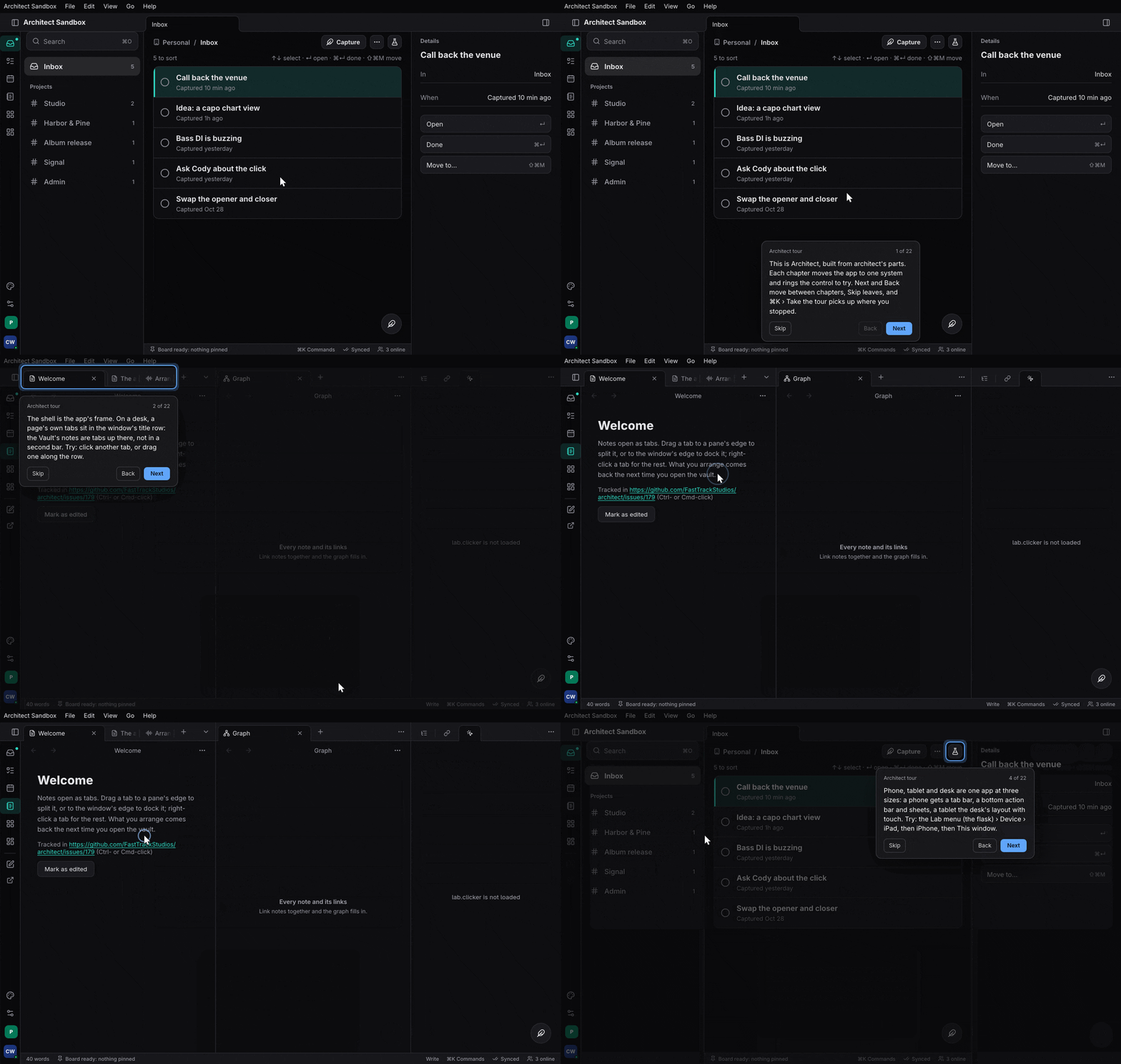
time, over the running app: each chapter moves the app to the right
place, rings the control it is about, and says in a few lines what it is,
why it matters and the one thing to try. Nothing in the sandbox is anyone’s
real data, so every control is live.
devenv up sandbox   # the sandbox under dx serve, plus Teley and its collector
just sandbox        # or the sandbox alone, without dx
just app            # the Architect app: its first run offers the tour
The tour starts on the sandbox’s first launch, and in the Architect app
once its first run has opened a vault (a chapter about a part the app
does not have yet, the Inbox or the Board, shows its text without a ring). After that, ⌘K › Take the
tour goes on where you stopped (or from the start, once you finished
it); Next and Back move between chapters, Skip leaves. An agent starts it
like anything else, over the Action List:
architect-sandbox actions run GUIDE_TOUR_START --arg id=architect-tour.
The chapters#
| Chapter | What it shows | Where to read more |
|---|---|---|
| Welcome | how the tour moves | this page |
| The shell | tabs in the title row, a page’s sidebar default and the rail, phone, tablet and desk | App shell |
| The workspace | splits, stacked tabs, docks, floats, pop-out windows, screensets, layouts as files | Workspace, Interface files |
| Runtime theming | THEME_SET, light and dark pairs, theme files read on save, $ref and mix(…) tokens, the magenta fallback, layers | Theming |
| The Action List | one list behind ⌘K, menus, keys, the CLI, MCP and the control socket | Actions everywhere |
| Agents | APP_STATUS, APP_SHOT, layouts and keys.json as files with a .error beside a bad save, clone-to-edit | CLI and MCP, Interface files |
| Extensions | the manager, the runners, EXT_CLONE and the way back, signed .archext archives | Extensions |
| Contributions | tabs, openers, status, menus, context menus, the phone bar, hooks, slots, sections | Extensions |
| Inline embeds | a fenced block drawn by an extension inside a note | Extensions |
| Workers and budgets | primes counted in a worker, a slow view kept on its last frame and marked busy | Extensions |
| Settings | the settings window as a built-in extension, sections arriving through a contribution point | Settings page |
| Pages | TSX, Luau and A2UI pages, live on save, the .error loop | Pages |
| Embedded views | Dioxus, Luau ImGui, a Frame surface, A2UI, the GPU paint view, CRDT documents | Embedded views |
What the sandbox cannot show, the chapter says: the Clicker (a process over
vox) and the WASI counter need their programs built beside the sandbox (WASI
with --features wasi), Keyflow’s editor and chart need --features keyflow-lab, the sandbox ships no .archext archive, and no lab extension
declares a service for another to use.
How it is built#
The tour is one guide scenario, apps/ui/tours/architect-tour.styx,
played live by architect-guide’s tour (features/guide/src/tour.rs;
Guide media). A chapter is its setup,
hidden steps that run Action List actions (LAB_GO, WORKSPACES_LOAD,
APP_SETTINGS, MANAGER_SHOW, EXT_VIEW_OPEN), and one step with the
text and the target to ring. Each chapter’s setup puts the whole app where
it needs it, because the tour runs it again on Back
(features/guide/src/tour.rs setup_of) and when it resumes at a step
(GUIDE_TOUR_START {id, step}, Tours::start_at).
The sandbox remembers the place through TourSet::on_move
(apps/ui/src/guide.rs tours): every chapter shown is written to
tour-place in the sandbox’s folder, and done once the last one is.
apps/sandbox/media/tests/tour.rs plays it as a person would, started from
the Action List and moved on with Next, and checks that every chapter
comes up with its target on screen; it also resumes it at a chapter and
goes Back. The scenario itself runs in just media-test with the others.