Sign-in, permissions and organizations
Sign a person in against the one identity server, keep the session and register the device; gate every service call with PermissionsGate; and make the organization the scope of everything, on the client and confined on the server.
Every FastTrackStudio app signs in to one identity server (apps/auth-server,
deployed as fts-auth) and reads the person’s organizations from it, so an
org is the same org in every app. In this chapter you will:
- sign a person in, keep the session, and put its token on every call;
- register the device on the person’s account;
- gate every service on the server with
PermissionsGateand permit tables; - give the client the person’s orgs, the window’s current org and the switcher, fetched live;
- key every layer’s data by
OrgId::path, and confine each server lane to its org; - read across every org for an “All organizations” view.
The crates: the auth family under features/auth (there is no
architect::auth re-export; depend on them directly),
architect-permissions (features/permissions), architect’s
crates/architect/src/permissions_gate.rs, and architect-orgs
(features/orgs).
1. Sign in and keep the session#
auth-client (features/auth/auth-client) is the client kit: wasm-clean,
protocol only (your app posts with its own HTTP client).
- A desktop or web app signs in with OIDC and PKCE:
oidc::authorize_url,Pkce::from_entropy,oidc::token_request_body, thenoidc::token_response_from(body)?.into_session(now), which keeps the refresh token. - A headless tool (a CLI, an agent) uses the RFC 8628 device flow:
device::start_body,device::parse_start,device::poll_body,device::parse_poll. - An app calling
AuthServicedirectly turns its sign-in answer into a session witharchitect_auth::client::stored_session(&bundle).
Keep the session in a TokenStore and attach it to every vox client with
TokenStoreMiddleware, which reads the store on every call, so a fresh
sign-in is picked up without rebuilding clients:
use auth_client::{FileTokenStore, TokenStoreMiddleware};
use architect_auth::client::stored_session;

let store = Arc::new(FileTokenStore::new(dirs.data_dir().join("session.json"))); // 0600
store.save(&stored_session(&bundle))?;                                          // after sign-in
let tasks = tasks_client.with_middleware(TokenStoreMiddleware::new(store.clone()));
store.clear()?;                                                                 // sign out
MemoryTokenStore is the wasm and test store. To stay signed in past the
access token’s hour, call oidc::refresh_if_needed(&store, client_id, now, send)
before a call and oidc::refresh_now after a 401; a Refused answer means
sign in again. Refresh tokens rotate, so run one refresh per store at a time.
2. Register the device#
The account keeps a device address book (features/auth/auth-proto/src/device.rs
DeviceService: register_device, list_devices, forget_device). Every
FTS app on one machine registers under the same device id, derived from what
the platform gives every app of one developer alike
(features/auth/auth-client/src/this_device.rs install_id, device_id),
so the account lists an iPad once however many apps run on it:
let registration = DeviceRegistration { /* device_id, name, platform, endpoint_id */ };
ensure_registered(&devices_client, &token, registration).await?;
ensure_registered only adds a row when nothing names the device yet,
unless the app has a node of its own (an iroh endpoint_id), which it
always keeps current. The answer is a DeviceDirectory. An app whose device serves peers runs
the whole pass instead, features/devices/src/account.rs pass (or
drive): it registers, holds the account’s shared org, and lets the
account’s other devices into the node’s Admission, which the
documents chapter’s NodeAccess checks for
device-to-device sync. See Devices.
3. Permissions: gate every call#
On the server every service call passes a PermissionsGate: it resolves
the caller (Principal) from the bearer token, asks a PermissionEngine
whether that principal may do the method’s action on its resource, and
replies permission denied: … in the method’s own response shape when not.
It fails closed: a method a table omits is denied, and so is a service with
no table (UnlistedPolicy::Deny, the default).
Write one permit table per service:
const NOTES: ServicePermits = ServicePermits {
    service: "notes",
    methods: &[
        MethodPermit::new("list", Action::READ, "notes/**"),
        MethodPermit::new("save", Action::WRITE, "notes/{id}"),
    ],
};
Then build the gate once and install it:
let gate = PermissionsGate::new(engine, Arc::new(SessionIdentityResolver::new(auth.clone())))
    .permit(notes_service_descriptor(), &NOTES);
let router = router.with_permissions(gate);
// or, per connection with its bearer: PermissionsGate::wrap_shared_with_bearer(Arc::new(gate), router, bearer)
- The engine.
RoleEngine(roles to rules),ScopeEngine(public or link scopes),CompositeEngine(several in order). An org’s server usesConfinedEngine(step 5). - Coverage.
gate.coverage(&router).is_complete()in a test proves every method of every mounted service is in a table and no table names a method that does not exist. - The caller in a handler.
architect::permissions_gate::caller()is the principal the gate resolved; it is task-local, so work spawned onto another task seesNoneand must refuse. - The same engine for actions. The gate covers service calls, not the
Action List’s in-process runs. Give the list the same engine
(
list.set_authorizer(engine)) so a model over MCP is checked by the same rules. - What the client may do.
PermissionsService(features/permissions/proto) is the affordance oracle: serve it from the gate’s own engine and resolver (Permissions::new(gate.engine(), gate.identity_resolver())) so the UI can dim what the person cannot do, and the answer cannot disagree with enforcement.
While migrating an existing server, observe_only(true) audits what would
be denied and lets everything through.
4. The person’s orgs on the client#
architect-orgs’ default build is the model: Org (id, name, the
person’s Role), Orgs (the list, the window’s Selection, cached on the
device), and Capabilities, the app’s own meaning of each role. Roles are
the org’s; what a role lets a member do in this app is the app’s:
let caps = Capabilities::new()
    .allow(&Role::Viewer, ["notes.read"])
    .allow(&Role::Member, ["notes.write", "files.write"])
    .allow(&Role::Admin, ["org.invite"])
    .inherit();                                   // each role gets the ones below it
Feature ui puts them in context and keeps them live:
let org = architect_orgs::use_orgs_provider(
    || cached_orgs(),                             // from the device's cache: works offline
    caps,
    Some(Callback::new(move |orgs: Orgs| keep_cache(orgs))),
);
architect_orgs::use_orgs_live(org, connection, |client| async move {
    architect_orgs::fetch(&client, &session).await.map_err(|e| e.to_string())
});
use_orgs_live fetches the person’s orgs (OrganizationService::list_organizations
with the stored session) when the connection comes up and again on every
reconnect (Connection::generation). A failed fetch keeps the cached list,
and OrgHandle::stale says why.
Anywhere below:
let org = architect_orgs::use_org();                       // Option<OrgHandle>
let current = org.and_then(|o| o.current());               // None in All
let can_invite = org.is_some_and(|o| o.can("org.invite"));
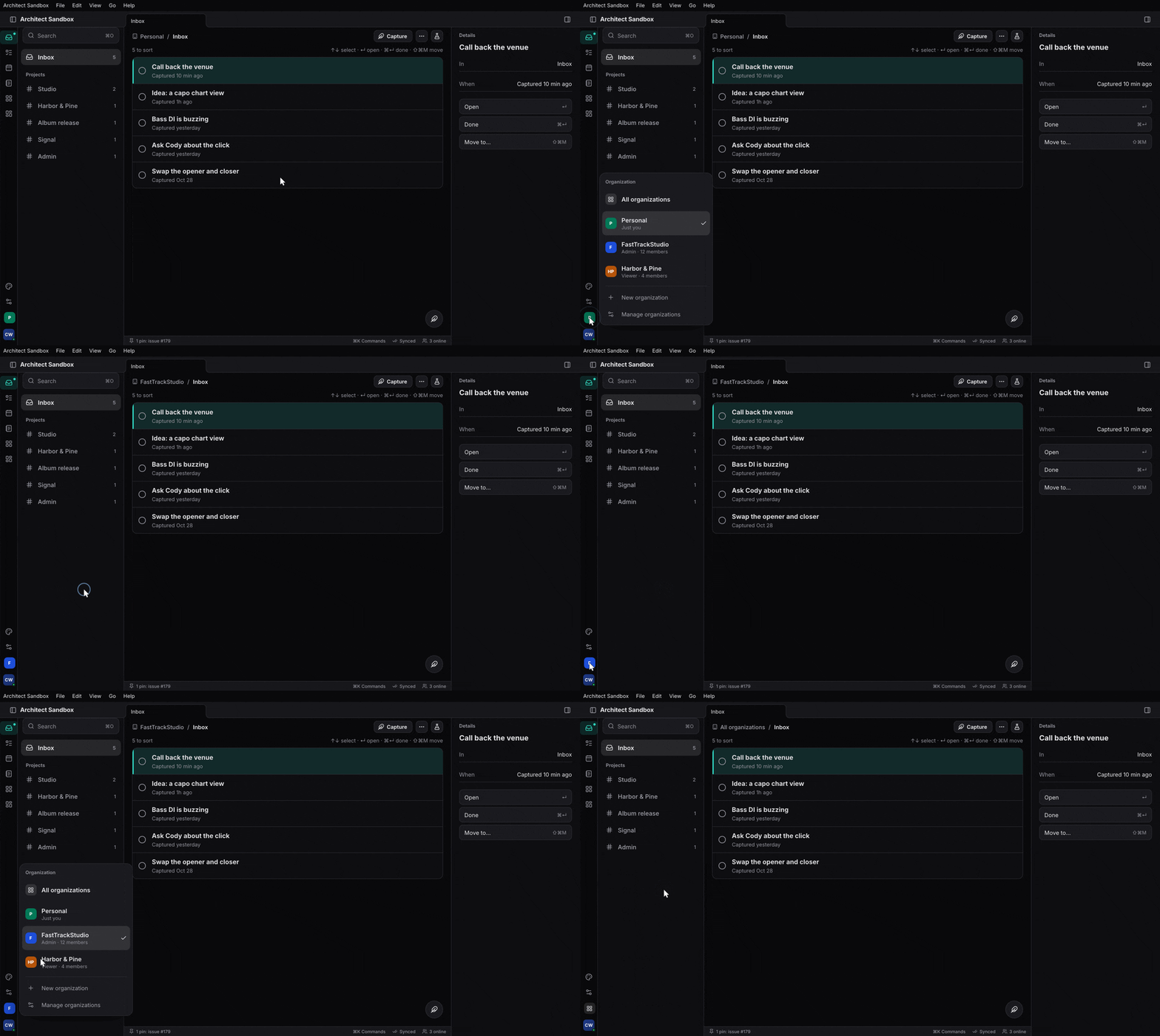
The shell’s switcher is org.switcher(Some("All organizations")), a
Workspaces to pass to AppShell { workspaces }
(UI chapter); picking one calls OrgHandle::switch.
5. The org as the scope of everything#
Every layer keys an org’s data the same way, OrgId::path, so files,
documents, settings and presence agree without knowing each other:
| Layer | Keyed by |
|---|---|
| Files | org.path("files/…") |
| Documents | the catalogue org.doc_id("catalogue"); a document’s blob under org.path("docs/<id>") |
| Settings | the org’s own under org.path("settings") |
| Presence | the org’s roster is the document org.doc_id("presence") |
| Permissions | resources org/<id>/… |
path gives org/<id>/<rest>; doc_id a v5 UUID of it, the same in every
app and on every device.
Server-side confinement#
An org’s server serves each org on its own lane (/org/{slug}/vox) and
confines every call on it (architect-orgs feature server,
features/orgs/src/server.rs):
Members::new(), shared by the next two.- Wrap your identity resolver:
MembersResolver::new(sessions, IdentityServer(orgs_client), members.clone())learns each session’s orgs from the identity server, at most once a minute per session. - Use
ConfinedEngine::new(members).role(&Role::Member, vec![Rule::new("**", &["read", "write"])])as the gate’s engine (.over(engine)adds yours after it). It refuses a caller who is not a member of the call’s org, any resource in another org, and what the caller’s role there does not allow. - Per connection, the org outside the gate so the engine checks the call
in it: on an
EngineHost,vox_at’s resolver returnsLane::new(router).scoped(org_id); on a transport of your own,confine(org_id, PermissionsGate::wrap_shared_with_bearer(gate, router, bearer))(it only takes a gated handler). - Handlers read
current_org()and key their data by it; work they spawn runsin_org(org, fut).
The lane’s org only says which org a call is in; without ConfinedEngine in
the gate nothing refuses a non-member. A gate with no All-organizations lane
sets ConfinedEngine::require_org(), so a lane left unscoped is refused.
features/orgs/tests/server.rs is the whole loop over a real vox link,
features/orgs/tests/host_lane.rs the same on an EngineHost lane.
6. All organizations#
In All, a read covers every org the person is in; a write needs one:
let scope = org.scope();                         // the window's org, or every org in All
let all = read_all(&scope, |id| async move { notes_in(&id).await }).await;
for item in all.items { /* Scoped { org, item } */ }
for (org, why) in all.failed { /* an offline org hides none of the others */ }
let target = scope.writes_to();                  // None in All: ask which org first
⌘O across orgs is scoped_opener (feature commands): it asks the
window’s org, or every org naming each item’s org, and opens an item in the
org it came from. On the server, a lane in no org serves these reads: its
resources name their org, and a service reads across Members::scope_of
the caller.
Where Task and Studio are#
Sign-in, devices, the gate, the org model, live fetch and confinement are
architect-side. Task still keeps its own OrgSelection and confines its
own lanes (with UnlistedPolicy::Allow and enforcement behind
TASK_ENFORCE_PERMISSIONS); Studio has its spaces. Moving both onto
architect-orgs, and files, documents, settings and presence adopting
the scope as each lands, is still to do. Which org’s settings apply, and
an admin’s page for them, are not built yet.
Where to read more#
- The auth feature: the RPC surface, the server, the client session kit.
- Organizations: the one identity server, the scope, confinement.
skills/architect/references/auth-permissions.md(gate decisions, principals, pitfalls) andskills/architect/references/fts-auth.md(the deployed issuer).
Linked from
- Build an app with architectA chapter-by-chapter walk through building a real app on architect: the contract, the backend, the server, the clients, the tests and the release.
- The UI primitivesWhat architect ships to draw an app with: architect-ui's components and theme tokens, the shell's page parts, every kind of tab and pane in the workspace, the commands overlays, the settings page, and architect-story to browse them.
- Documents, sync and filesAn app's work as CRDT documents: kinds and named undo, the document file, sync to the org through the org driver, peer to peer by link and on the LAN, presence and collaborative text, blobs by hash, and Files.